
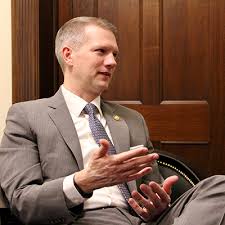
A United States congressman, Riley M. Moore, has called for the repeal of Sharia and blasphemy laws in parts of Nigeria, citing what he described as ongoing persecution of Christian communities.
Moore made the recommendation in an official congressional report presented to US President Donald Trump at the White House, according to a press release issued in Washington.
The lawmaker said he joined members of the House Committees on Foreign Affairs and Appropriations to submit what he termed a “comprehensive report outlining concrete actions to end the persecution of Christians in Nigeria and counter growing extremist violence in the region.”
Nigeria was redesignated on October 31, 2025, as a Country of Particular Concern (CPC) under the US International Religious Freedom Act by President Trump, a move that formed part of the backdrop to the report.
Moore disclosed that the president tasked him and Tom Cole, Chairman of the House Appropriations Committee, with leading a congressional inquiry into Nigeria’s security challenges and alleged persecution of Christians.
According to him, the report followed months of investigation, including a bipartisan fact-finding trip to Nigeria, expert hearings, consultations with religious leaders, meetings with internally displaced persons, and engagements with senior Nigerian government officials.
“I travelled on a bipartisan delegation to Nigeria and saw with my own eyes the horrific atrocities Christians face, and the instability the Nigerian government must combat,” Moore said.
Key Recommendations
Among its proposals, the report advocates the creation of a bilateral security pact between the United States and Nigeria to safeguard vulnerable communities and dismantle jihadist networks.
It also recommends withholding certain US funds pending “demonstrable action” by the Nigerian government to halt violence against Christians. Additionally, the document suggests sanctions and visa restrictions against individuals and organisations found to be complicit in religious persecution.
One of its most controversial recommendations is the repeal of Sharia and blasphemy laws. Sharia courts operate alongside secular courts in 12 northern states, primarily handling civil and personal matters for Muslim residents.
Human rights groups have previously criticised aspects of blasphemy laws, raising concerns over due process in some cases.
The report further calls for collaboration with foreign partners such as France, Hungary, and the United Kingdom, as well as technical support to address violence attributed to armed Fulani militias.
Moore said the document outlines steps to “impose accountability measures, counter radical Islamic terrorism, and work in coordination and cooperation with the Nigerian government to bring security to all the people of Nigeria.”
Nigeria’s Security Context
Nigeria has grappled with multiple security crises for nearly a decade. The northeast continues to face insurgency led by Boko Haram and its affiliate, Islamic State West Africa Province.
In the northwest and north-central regions, armed bandits and criminal gangs have carried out raids and kidnappings, while long-standing farmer-herder clashes in the Middle Belt have frequently taken on religious dimensions.
Successive Nigerian governments have rejected claims of state-sponsored religious persecution, maintaining that insecurity affects citizens of all faiths and ethnic backgrounds. Authorities have consistently pledged to uphold religious freedom and prosecute offenders irrespective of religion.
As of press time, the White House had not announced specific policy steps following the submission of the report. Analysts caution that sanctions or restrictions on US assistance could strain diplomatic ties between Washington and Abuja, which cooperate on trade, regional security and counterterrorism efforts.